The post What If Plan “B” Could Become Plan “Better”? appeared first on BUILDING WHAT MATTERS.COM.
]]>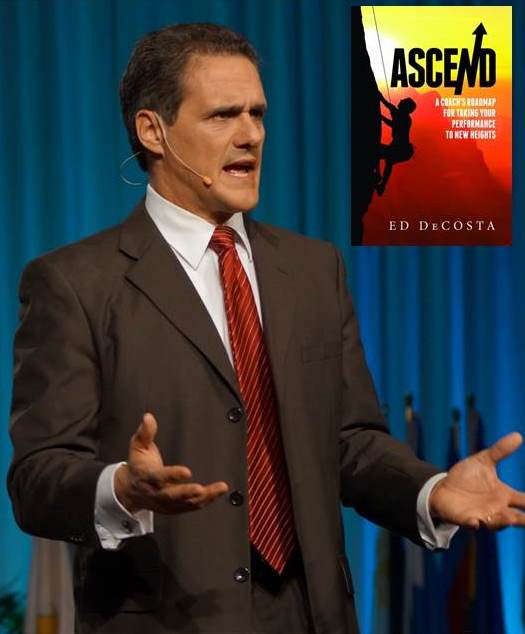 Last week on our Platform Builders Mastermind call. we spotlighted one of the Maxwell Team mentors, Ed DeCosta, who recently release his new book ASCEND: A Coach’s Roadmap For Taking Your Performance To New Heights.
If you want some “no-nonsense, get results” strategies for reaching new levels of achievement, you will find it in ASCEND. But it’s not the book that inspired this post, it was something Ed said on the call.
Ed made the statement that “Sometimes Plan B needs to be Plan Better.” [Tweet This]
I don’t think Ed even realized the genius in the statement when he made it, but genius it is. That comment changed my entire thought process on the idea of a “backup plan.” You see, that’s what I’ve always thought a Plan B was – the option when the desired one doesn’t work. Not any more!
If you have been settling for Plan B, Knock it off!
Maybe you are a lot smarter than me and have already figured this out, but for me, Plan B has always been the backup plan just in case Plan A didn’t work out. Right? Look, being smarter than me is not any kind of earth shattering accomplishment but changing your perspective on this just might be. If you have conceded that Plan B is always less desirable than Plan A, Knock it off!
What if we looked at Plan A failing not as a failure, but as an opportunity to learn and seize the opportunity to make Plan B – Plan Better. What if Plan Better doesn’t work? Well, you can call it whatever you want, but by learning lessons instead of conceding defeat, we can continue a path towards success.
Start learning lessons instead of conceding defeat!
Full transparency here, I just came into this awareness less than a week ago and although I have not had a chance to put it to the test yet, I do have some big “Plan A” activities that will be put to the test this week and this I know – if I have to go to the backup plan, it will be Plan Better.
I think our culture has conditioned us to believe that acceptance of thinking that our results are “good enough”, “better than than they use to be”, or “at least different than they were before” are reasonable outcomes. Nonsense!
Start setting yourself up for success!
The whole idea of setting goals and stretching outside our comfort zone are to produce what we have not achieved before. Why do we settle for less than we desired? Why is better OK when best is what we are shooting for? Why do words live “CAN’T”, “NEVER”, and “ALMOST” remain in our daily vocabulary?
I think it’s because we have lowered our standards. And by doing so, we have lowered our own self-image. Ed and the other Maxwell mentors all adhere to the belief that we will never out perform our own self-image.
When Plan A doesn’t work, we immediately jump to the next best choice instead of creating a BETTER one. Peter Drucker had some thoughts on this when he said:
“The best way to predict the future is to create it.” [Tweet This]
TODAY’S QUESTION: Are you following a downward progression in your decision making process that will ultimately net you less of a result than you originally desired?
TODAY’S CHALLENGE: Learn from the Plan A’s that didn’t work out and set yourself up for success by making Plan B – Plan Better!
***********************************************************************
===> JOIN THE “LEADERSHIP BY INVITATION” LAUNCH TEAM <===
Click here to get a copy of my Kindle Book “The Manifesto Of An Influential Leader”
Don’t miss a single post from Building What Matters by subscribing at the top left of this page.
Help support us by clicking here and Liking our facebook page
Barry Smith 4/14/14 photo by author © Building What Matters 2014
The post What If Plan “B” Could Become Plan “Better”? appeared first on BUILDING WHAT MATTERS.COM.
]]>The post The Men Who Built America – Thomas Edison appeared first on BUILDING WHAT MATTERS.COM.
]]> Well here we are, a new year and a new plan, right? I know this – the Platform Builders have some new plans for 2014 and this year we are starting our Mastermind study with a little twist.
This month we are masterminding through The Men Who Built America, a DVD produced by the History Channel along with Think and Grow Rich by Napoleon Hill to compliment the mini-series built around some of the great early leaders and entrepreneurs that help build the United States into a world power at the end of the 19th Century.
If you don’t know the back story on how these two connect together, Napoleon Hill was commissioned by Andrew Carnegie to study the most successful people and find out what resulted in their success. The men who built America were among many of the 20,000+ that Hill interviewed over the twenty year period it took him to write the book.
This month we are going take a look at Andrew Carnegie, Thomas Edison, JP Morgan and Henry Ford. In this, the second of four posts, we will take a look at Thomas Edison.
Edison, the holder of 1,093 U.S. patents, is most recognized as the inventor of the light bulb. Also credited for the phonograph and motion-picture camera, Edison was much more than an inventor. His inventions set the world on the pathway to modern electricity and global communications.
So how did a man with only three months of formal education and whose hearing was impaired at an early age become “one of the men who built America?”
You Don’t Need Ears To Hear!
THOUGHTS ARE THINGS
“The value of an idea lies in the using of it.” – Thomas Edison
What if Edison never imagined his thoughts and ideas as things. Ideas are great, but as Hill shows in the story of how Edwin C. Barnes partnered with Edison, you have to treat them as such. An idea will not become reality until it is brought to life by the hand of the one who conceived it. How many ideas do you have that never come to life? Have you considered the power you hold within you to manifest your thoughts into reality? Here lies the great opportunity to ask; How can I?”
So what if nobody ever did it before!
FAITH
“Be courageous. I have seen many depressions in business. Always America has emerged from these stronger and more prosperous. Be brave as your fathers before you. Have faith! Go forward!” – Thomas Edison
Hill provides a very interesting definition of faith. “A state of mind which may be induced, or created, by affirmation or repeated instructions to the subconscious mind, through the principle of autosuggestion.” Edison simply refused to believe that something could not be done. He had the faith that with enough perseverance and effort, anything could be accomplished – even when “common sense” might suggest otherwise.
Mach 3 with your hair on fire!
THE BRAIN
“It is astonishing what an effort it seems to be for many people to put their brains definitely and systematically to work.” – Thomas Edison
The brain continues to be one of the most studied and least understood parts of the human body. But even in Hill’s time, it was accepted that the brain was a powerful machine that could actually create it’s own energy. Edison was continually pushing his thinking to new levels. He constantly tapped his own awareness of what he knew and filled in the blanks with what he pulled from others. Viewed as a curse by many, part of Edison’s genius is that his mind never quit working. Turning though into action, over and over, produced more inventions than anyone else in history.
Most equate the success of these men to industry and the technological advances of their time. I think the simple truth is that these men just thought better than everyone else. Edison makes a simple but powerful statement when he said; “Everything comes to him who hustles while he waits.” (Tweet This / Share on Facebook / Post to LinkedIn) The men who build America were always hustling – at least mentally.
This will be a great mastermind study. None of these men were angels, but one thing about them – they never let anyone else limit what they could do.
Your brain is constantly producing new thoughts. So I have a few question for you to ponder today. What are you doing with your ideas? How many times do you thing the words “that’s never been done before” described something that had just been done?
***********************************************************************
Click here to get a copy of my Kindle Book “The Manifesto Of An Influential Leader”
Don’t miss a single post from Building What Matters by subscribing at the top left of this page.
Help support us by clicking here and Liking our facebook page
Barry Smith 1/15/14 photo courtesy of Amazon © Building What Matters 2014
The post The Men Who Built America – Thomas Edison appeared first on BUILDING WHAT MATTERS.COM.
]]>The post Failure Won’t Ruin You, It Will Reveal You! appeared first on BUILDING WHAT MATTERS.COM.
]]> National Quit Day has come and gone. My hope is that the “why” behind your 2014 goals was strong enough to keep you on course and that you continue to productively pursue the goals that will make 2014 your most successful year yet.
If you are still on track with your goals – good on you. That being said, it takes about 30 days to start a new habit or become consistent in the transformation you are seeking. It will probably get a little tougher before it get’s easier.
I don’t want to jinx the future, but I believe this post will help you through the tough times as you take on these new challenges. One of my mentors taught me that failure won’t ruin you, it will reveal you. What does that mean? What I believe it means is that as you begin to slip from your commitment to heading to the gym, writing 500 words a day or whatever else it might be, challenge yourself to understand what is being revealed in that failure.
Sometimes You Win, Sometimes You Learn!
Remember what John Maxwell says; “Sometimes you win and sometimes you learn.” You see, failure won’t ruin you. You have attempted many goals in the past and like all of us, have failed almost as many times. That doesn’t have to be the end. But here is the deal – you won’t achieve every goal you set out to. Sorry – simply speaking the truth here. I am more concerned with why we fail. More specifically – what is revealed in the process.
It has been said that; “When you have a strong enough WHY, the how will take care of itself.” (Tweet This / Share on Facebook / Post to LinkedIn)
So put your why to the test. When you fall short you have two choices. You can look at it as failure or you can see what is revealed during the process.
Plan Your Work And Work Your Plan!
Maybe your why is strong enough, but you have failed to set yourself up for success and left out a key ingredient to success. Maybe the environment you are in is not conducive to your success. Achieving goals is much more than simply the desire to change or start something new. You need a game plan – and one that will work.
I think the biggest reason people don’t achieve their goals is because they don’t put enough thought into the way to achieve the goal. They simply write down on a piece of paper what they want to achieve, tape it to the refrigerator and hope that looking at it a few times a day will give them the motivation they need to achieve it.
The Fifteen Minute Miracle
I know many of you are killing it so far. On track and feeling strong. Some of you may be struggling or have already given up on one or more of the goals you set for 2014. There is nothing wrong with the idea of “don’t fix it if it’s not broke” but if there is an opportunity to get better, why not consider it? Don’t give up! There is still time to get back on track – maybe all you need is a little more clarity and a slight course correction.
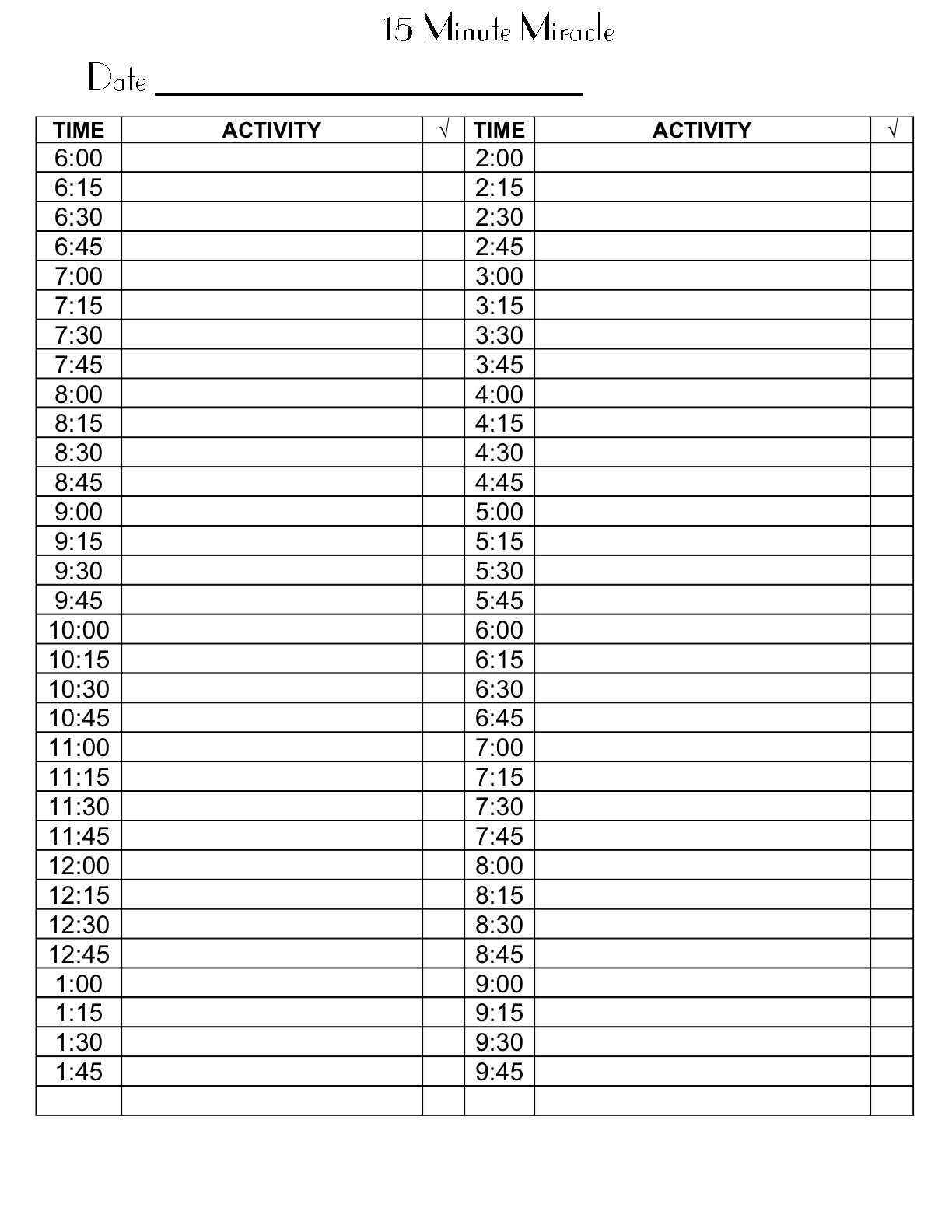
15 Minute Miracle
I lead a group of new members to the John Maxwell Team through a 90 Day Success Roadmap and one of the resources we use is called the 15 Minute Miracle. This very simple and highly powerful tool almost guarantees success – if you use it right – and will make you much more productive immediately.
All you have to do is break down your day into 15 minute increments. What? That’s it? Yes! I know what you’re thinking … it can’t be that easy. Well it’s not – it’s not because you have to actually do it and do it consistently. Give it a shot and tell me I’m wrong.
A simple but very important question for you today. Have you created the right plan to achieve your goals? Remember – set yourself up for success! When you face failure, ask yourself what is being revealed – what has contributed to the failure and how can I change it.
***********************************************************************
Click here to get a copy of my Kindle Book “The Manifesto Of An Influential Leader”
Don’t miss a single post from Building What Matters by subscribing at the top left of this page.
 Help support us by clicking here and Liking our facebook page
Barry Smith 1/13/14 photo by author © Building What Matters 2014
The post Failure Won’t Ruin You, It Will Reveal You! appeared first on BUILDING WHAT MATTERS.COM.
]]>The post If I Had The Self-Confidence To Do It, I Would _____________! appeared first on BUILDING WHAT MATTERS.COM.
]]> Look at that, I already have you thinking and you haven’t even got past the title of the post yet. I love it when that happens.
Self-confidence is one of those funny things. You don’t really understand it until you get it. No, not “get it” like understand it, I mean get it like “get it.” Self-confidence is a process and a difficult one at that. Our culture does several things to keep you from getting it as well as giving it to you under false assumptions. Let me explain.
First, the world we live in teaches that failure is bad and that the more you fail, the worse off you get. If you have been reading any of my posts lately, you know that failure is actually a means to success. From failure we not only learn the wrong way to do things, but we also learn that doing things wrong is ok because we can learn from those “failures” and build our confidence from the lessons learned.
Second, our society has gone overboard to make sure that everyone feels good. Somehow by rewarding people, especially children, for everything they do will somehow build up their self-esteem and self-confidence. Well I suppose it will short term, but what happens when they get into the real world where simply “participating” get’s you just about nothing?
You can choose to agree or disagree with my comments in the previous two paragraphs but the bottom line is that “authentic” self-confidence is the only thing that will provide lasting results. So let’s take a look at the idea of self-confidence.
WHY DO I NEED SELF-CONFIDENCE?
Self-confidence is the tool that allows you to be you. Not just you, but the best you that you can be. We all have beliefs and those beliefs make up who we are. The problem is that when we don’t have the confidence to “walk our talk” it results in a less authentic model of who we are. Maybe even someone we are not.
WHERE DO I GET SELF-CONFIDENCE?
You build self-confidence by doing the right things at the right times no matter what other people will think. If this is a new concept for you, it won’t be easy at the beginning. But continue and people will recognize you as a trusted, respected individual. Even if they don’t agree with you, they will appreciate the fact that you actually believe in something and are willing to stand behind it.
WHAT DO I DO WITH SELF-CONFIDENCE?
Do you consider what other people will think of you when you speak or act in a certain way? Or are you so totally convicted by what you believe in that you will do what you do and say what you say regardless of what other people think. Now I am not saying don’t be respectful or courteous, just be solid in who you are. That is what self-confidence does for you. As my mentor John Maxwell has taught us; “you cannot give what you do not have.”
Go back to the title of this post. What would you try if you had the confidence to do it? I know there is at least one thing. Did you know that most people have more regrets for things they wanted to do and didn’t than things they did do and wish they hadn’t? [Tweet This]
Simple challenge for you today folks. Make a list of the things you want to do but have not had the self-confidence to do, pick one, and GO DO IT!
***********************************************************************
Click here to get a copy of my Kindle Book “The Manifesto Of An Influential Leader”
Don’t miss a single post from Building What Matters by subscribing at the top left of this page.
Help support us by clicking here and Liking our facebook page
Barry Smith 12/9/13 photo by author © Building What Matters 2013
The post If I Had The Self-Confidence To Do It, I Would _____________! appeared first on BUILDING WHAT MATTERS.COM.
]]>The post What Are You Willing To Sacrifice In Order To Grow? appeared first on BUILDING WHAT MATTERS.COM.
]]>
1 oz. of Gold from the Yukon
Friday night I attended a “Gold Rush” season premier party. For those of you not familiar with the show, it revolves around three groups of gold miners chasing their dream to find the elusive shiny mineral and strike it rich.
Part of my interest in the Discovery Channel hit is that I personally know some of the characters. For that reason, the “behind the scenes” footage always catches my interest.
Now in season four, we have watched the characters give up or “sacrifice” the life they have at home and head north in search of buried treasure. This season, one group led by Todd Hoffman and Dave Turin is actually mining in Guyana, South America.
The show is clearly a hit, but four years ago when these men left their families behind, they had no idea if they would find gold or not. They had to make difficult choices and had to be willing to sacrifice what they had for nothing more than the hope of hitting it big.
The “on-site” action clearly makes the show but the producers have done an incredible job showing what these ambitious individuals have had to give up. Everything has a price right? This season was no different as they showed the scenes of dad’s and husband’s saying goodbye for five months.
Aside from the pure adventure of gold mining, it is clear, at least to me, that these adventurers are not only living a dream but creating a legacy. If you are a fan of the show, you know that teamwork has been the key to their success. John Maxwell gives us some sacrifices that we have to consider when we want to do more and be more when working with teams.
Make Financial Sacrifices For The Team
Most of these people have leveraged everything to get started and to acquire the needed resources to become successful miners. Decisions had to be made and they all sacrificed the security that they had to become collectively successful.
Keep Growing For The Sake Of The Team
The shows main characters have stayed pretty much the same, but some changes have been made to make sure the teams are comprised of committed individuals that are willing to do what has to be done. Whatever that might be.
Empower Others For The Sake Of The Team
This is huge to me. I have watched the leaders face very difficult decisions, yet the vision was made clear and more importantly, shared with the rest of the team. Each individual knows that they are an important part of the team and sharing in the responsibility has empowered them to work together towards that common goal.
Make Difficult Decisions For The Sake Of The Team
Every season has had major challenges and each team has had to overcome major adversity. The leaders of each group have stepped up to the plate and made those difficult decisions and owned the results. Some of the choices made have not worked out, yet they continue to not fail, but learn and become better for it.
The bottom line is this, all these individuals have sacrificed on many different levels, but the leaders have had to sacrifice their pride when making the wrong decision. They have been quick to share the success but just as quick to own their failures and in doing that, have gained the respect from their teams.
The entire world might be watching on their television set but for these men and women, every day is real. They have made sacrifices to get there and they make sacrifices every day to get it done. The leaders set the attitude by being willing to do themselves, everything they expect from their team.
My question for you today is this: Are you asking your team to make sacrifices that you are not willing to make yourself? Doing so may explain the lack of commitment you are seeing.
***********************************************************************
Click here to listen in on October 30th as John Maxwell shares how to “Influence through Connecting”
Don’t miss a single post from Building What Matters by subscribing at the top left of this page.
Help support us by clicking here and Liking our facebook page
Barry Smith 10/28/13 photo by author © Building What Matters 2013
The post What Are You Willing To Sacrifice In Order To Grow? appeared first on BUILDING WHAT MATTERS.COM.
]]>The post The Myths Of Creativity – Who’s Idea Is It Anyway? appeared first on BUILDING WHAT MATTERS.COM.
]]>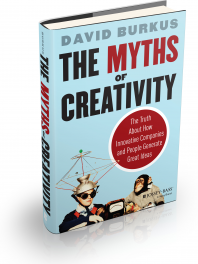 I have been having a lot of fun being part of the launch team for “The Myths of Creativity – The Truth About How Innovative Companies And People Really Generate Great Ideas” by David Burkus. I never really put much thought into the idea of innovation and creativity … or did I?
Burkus has totally changed the way I think about the topic of creativity. He does an outstanding job of describing ten myths that I believe clearly demonstrate that there is creativity within all of us. Most of us just don’t know it.
Many of you know that I am constantly reading. One of the reasons I read is that I think being constantly subjected to the ideas of others helps me to expand my own thinking. Burkus takes this same thought process and shows how our collaboration with others is the real key behind innovative creativity.
I found one of his myths, the Originality Myth, quite interesting. He uses two stories, one about Alexander Graham Bell and the telephone and the other about Steve Jobs and Bill Gates regarding “windows” and the graphical user interface (GUI). If asked “who invented the telephone or the “windows” on your computer, most people would answer with one of the names above. If you want to know the truth – order the book!
But here is the point. All creativity, innovation and all good ideas are really the product of what someone did before them. Bell simply refined what had already been discovered in the telegraph. Gates and Jobs merely expanded on what Xerox had done years before.
In all honesty, I knew there was more to these stories before reading the book, however, my understanding of what creativity really is and how we get creative has changed considerably.
Burkus discusses these ten myths that are really limiting beliefs that keep us from innovation at both the personal and organizational levels. Not only does he reveal these myths, but he provides clear direction on how to overcome the challenges that hold us back. You know I love anyone who battles against limiting beliefs!
I look at myself and the things I have been doing over the last few years. I have been doing things that I never dreamed I would be doing. Creating my own content, developing an entire new career and identity and even constructing this website. I know – nothing special – but it’s mine; I created it.
But here is the point that Burkus makes. None of this was my idea. It is simply a combination of watching, learning, and applying what other people know into what I do. Now here is the sweet stuff – if creativity is really the organization of what other people have already done, in a new way, there is no limit to what we can do.
I have only really pulled the thoughts from one of the myths that Burkus offers in this book. If you have any desire to expand your ability to come up with good ideas and how to turn that into major achievement, grab a copy of The Myths Of Creativity.
My challenge for you today; Don’t be afraid to share your ideas with others. Even if it does not make sense or seem possible, it may spur some similar thinking in someone else and who knows what you might collectively come up with. After reading this book, I realize that no good idea was the product of one thought by one individual. Be that catalyst to the next major breakthrough that comes along. What do you have to lose?
***********************************************************************
Don’t miss a single post from Building What Matters by subscribing at the top left of this page.
Help support us by clicking here and Liking our facebook page
Barry Smith 10/17/13 photo courtesy of Amazon © Building What Matters 2013
The post The Myths Of Creativity – Who’s Idea Is It Anyway? appeared first on BUILDING WHAT MATTERS.COM.
]]>The post Sometimes You Win, Sometimes You Learn – It’s About Attitude appeared first on BUILDING WHAT MATTERS.COM.
]]>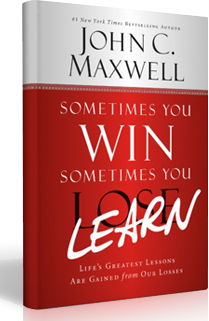 A few days ago I watched John Maxwell’s webcast introducing his latest book; Sometimes You Win, Sometimes You Learn. When John was asked what the main topic of this book was; he replied “attitudes.” I totally agree. Why? Because I believe winning, losing and learning are all connected to your attitude.
The main premise of John’s 74th book is that we don’t have to lose. Rather, we can learn from our failures and mistakes. John shares some of his greatest blunders and simply stated, he kept a positive attitude when it could have been just as easy to give in or give up.
I’ll admit that I used to be that way when things went wrong. Blame it on the circumstances or possibly even on someone else just so I wouldn’t look bad. I am over that mindset now. Now I realize that failure is actually part of success. When we understand this, we are able to maintain a positive attitude which allows us to remain focused on the original goal or objective we set out to achieve.
I want to discuss four ways that our “attitude” impacts our life. These are not just opinions, these are thoughts based on my own failure and success. I used to try and hide my failures and losses from others. Now I wear them like battle scars and love to share with others, what I learned from the experience.
PERSONAL RELATIONSHIPS
This could be your spouse, significant other, or even one of your kids. If there is a problem in the relationship, I promise you that it has something to do with the attitude of one, or both of you. My advice, remember this is based on experience, own your behavior and act in a way focuses on a solution. A positive attitude can make all the difference in the world and may be your only hope to finding resolution.
BUSINESS RELATIONSHIPS
I have watched it over and over, attitudes are contagious. Much of the success we have in the business world relates in one way or another to teamwork. When you are part of a team, you have a responsibility to your teammates to be an addition to the team. This never happens with a negative attitude. One single bad attitude can divide an entire team. That being said, one positive attitude can be the catalyst to team success.
HEALTH
We all know that stress is bad for us, and on many different levels. I am not breaking any ground here by telling you that your attitude will determine your stress level. Notice that I didn’t say your stress will determine your attitude, even though it might, but here is the deal. When we have a positive attitude, we reduce stress. A negative attitude creates stress. Our attitude is our choice – something we have control over. Stress is the result of our choosing to have a poor attitude or by allowing others to control our decisions.
SUCCESS
Here is the important piece to all of this. What if you never lost? What if everything you did was a win or a learn? How would that impact your attitude? Look, I get it, sometimes there is so much stacked against and we feel so overwhelmed that it is nearly impossible to maintain a positive attitude. But this is what happens when we have that “positive attitude” mindset – we look at things differently and some of the things that used to get us down, now get us excited. Excited to learn and apply that lesson to do or get better. That is how we succeed.
So a challenge for you today. Identify something in your life, right now, that has you frustrated or even angry. Take a moment to reflect on what it is and what you can learn from going through this experience. As John says in his new book; “Success lies not in eliminating our troubles and mistakes but in growing through and with them.”
We all will experience difficulties in our life. I believe our attitudes will make the difference between winning and losing. So no more losing, only learning!
***********************************************************************
Don’t miss a single post from Building What Matters by subscribing at the top left of this page.
Help support us by clicking here and Liking our facebook page
Barry Smith 10/12/13 photo courtesy of Amazon © Building What Matters 2013
The post Sometimes You Win, Sometimes You Learn – It’s About Attitude appeared first on BUILDING WHAT MATTERS.COM.
]]>The post Is There A Risk With Every Reward? appeared first on BUILDING WHAT MATTERS.COM.
]]> Do any of these sound familiar? “Don’t take the risk.” “It’s too risky.” “You have too much to risk.” Through our childhood years, the word risk is equated almost always to danger. Yet when we get older the mantra changes to “No risk, no reward.” Why is that?
I think when we are young, we don’t know any better. We are not yet aware of the things that can hurt us. Unfortunately, for many of us, that mindset never changes. We grow into our adult years still believing that “risk” is just another four letter word we need to avoid.
Warren Buffet said; “Risk comes from not knowing what you’re doing.” So does that mean that the only reason that we don’t take risks is because we don’t know what we’re doing?
I think I follow Buffet’s wisdom on this. If we know exactly what we are doing, we don’t eliminate the risk, but we certainly reduce it. So how about a few more phrases … “calculated risk”; “controlled risk” or “limited risk.”
OK, I’m already tired of the word. No more risk!
Oh, I forgot – No risk, no reward!
There has been much written lately about failure and how it is really a part of every success story in one way or another. John Maxwell’s next book, “Sometimes You Win, Sometimes You Learn” comes out next month and it is all about learning from our failures. I listened to this months Success Magazine CD and three interviews about – you guessed it – failure. Everyone’s writing about failure.
If you are familiar with the Success CD’s, you know that Hardy does a short wrap up at the end of each issue. He made a comment that took the dim light in my head from about 10 watts to 100 watts with this statement; “The best way to massive success is through massive failure.” Ok, full transparency here – it was more like slowly turning up the dimmer switch.
I was so excited that all I had to do to succeed was fail, that I almost missed the real meaning here. If I fail enough times and learn from them, eventually I will succeed.
One of the things I am currently working on is building my client base. So I thought some more about Hardy’s comments and decided that I have a new goal. I am going to fail 100 times by the end of the year in getting a new client. (If you are reading this and get a phone call from me in the next few months, don’t feel like you have to be one of the 100.)
Here’s the real “aha” in all of this. I didn’t get it at the time, but the following day I was on a call with my coach and after explaining this great discovery, she made this observation; “Looking for No’s takes the fear out of rejection.” BOOM!
So what does this mean? It means that I am crystal clear on my objective – “to receive a no.” The risk has been reduced (even if it’s only in my own mind) about failing to get a yes. Therefore, the limiting beliefs that may have held me back in the past, waiting for that “perfect client” or worse yet, “waiting for that person to call me” are gone.
I want a “NO.” Remember what Hardy said – Massive Success comes through Massive Failure. My favorite President, Theodore Roosevelt, said; “It is impossible to win the great prizes in life without running risks.” He was right. It not’s going to come easy and nobody is going to do it for you.
So is there a risk with every reward? Probably not every one. But this I believe – the big rewards come with some kind of risk. Today’s question: “How much are you willing to risk?”
It’s bonus Friday, so you get a question and a challenge, so here it is. There is a risk you have not been willing to take. You know what it is. Don’t be afraid of taking the risk. Educate yourself on what it is you want to do and go for it. If you get your “no”, you can try again.
Now don’t tell anyone that I wrote this last paragraph because this post is about risk and being good with receiving a “NO.” OK – I am whispering now “What if they say yes!”
***********************************************************************
Don’t miss a single post from Building What Matters by subscribing at the top left of this page.
Help support us by clicking here and Liking our facebook page
Barry Smith 9/13/13 photo by author © Building What Matters 2013
The post Is There A Risk With Every Reward? appeared first on BUILDING WHAT MATTERS.COM.
]]>The post Is Competition The Catalyst To Success? appeared first on BUILDING WHAT MATTERS.COM.
]]> Do you think that competition, in itself, will push you to go further that you have gone before? I believe that it can be a huge catalyst to pushing you beyond the limits that you thought you could reach.
At the same time, the lack of competition may represent true teamwork. OK, great, now what do I do? Compete or lay down and roll over? I never said give up. There is a big difference between “not competing” and “throwing in the towel.”
I am currently with about 600 of my John Maxwell Team colleagues who will be focused on learning better and smarter ways to add value to each other this weekend. One of the most impressive things about this team is that there is relatively no competition within the team.
Almost 3,000 worldwide, this team works to support each other. Not only on an individual basis, but in our business building as well. Individual success stories are often shared, but they are shared with the intent to teaching others how to do the same. There are no trophies awarded or recognition for being “more successful” than the other members of the team. That’s what makes this team different.
I have never been involved with a team of so many givers and in almost every case there is no expectation of anything in return. We support and encourage each other and help in every way possible to take our teammates to the next level of success.
I find it interesting in such a competitive world that there is relatively little focus on competition or why the “Maxwell Philosophy” may be a better choice for coaching, training and speaking business opportunities. The mindset is not an “either or” but a “in addition to.”
We have access to the resources created under the brand of the top “leadership guru” in the world and bring the most current thoughts in leadership development to the market place. An international team of mentors, all in the top of their respective fields pour into us on a daily basis with the push to be the best we can be in whatever we do.
The idea of competition suggests a winner and a loser. The Maxwell philosophy is about everyone winning. By Monday night, there will be over 400 newly certified team members to head back into the world to add value to everyone they serve.
So is competition the catalyst to success? Maybe yes and maybe no. I believe that it depends on how you are defining success. If success is beating out your competitor and gaining a contract, I suppose it could be said that competition was the drive that got you there.
If on the other hand, success is achieving the opportunity to add value and serve your client to help them reach their potential, than it’s not really about what you get, but what you give. This is the true definition of servant leadership. Servant leadership is part of the Maxwell philosophy and serving does not require competition, it required dedication and commitment.
So I have a question that should make you think a little harder than most of my questions but I think it’s an important one. I have written many times that the better the question asked, the better the answer received. So I would like to challenge you to ask a better question.
Instead of thinking about who you are competing against, consider what you are competing for. Vince Lombardi said “It’s not whether you win or lose, it’s how you play the game.” I believe competition is not about who wins and who loses, it’s about what is gained in the process. So what are you competing for?
***********************************************************************
Don’t miss a single post from Building What Matters by subscribing at the top left of this page.
Help support us by clicking here and Liking our facebook page
Barry Smith 8/9/13 photo by author © Building What Matters 2013
The post Is Competition The Catalyst To Success? appeared first on BUILDING WHAT MATTERS.COM.
]]>The post How Positive Thinking Can Make Failure Your Friend appeared first on BUILDING WHAT MATTERS.COM.
]]> I took part in a great Leadership Live Google Hangout yesterday with some friends and colleagues of mine in the #LeadWithGiants Google+ Community. My friend LaRae Quy co-hosted along with host Dan Forbes.
Quy, who spent 24 years as an FBI agent, provided some of her insights on the topic of failure and how it is important to fail. You can read her full article by clicking here, but here are her 5 reasons that may just change the way you look at failure:
- Failure Develops Persistence
- Failure Builds Mental Toughness
- Failure Defines Willpower
- Failure Makes You Smarter
- Failure Raises Curiosity
In short, Quy describes two types of failure. One is the result of not doing something because it pushes us outside of our comfort zone and the other comes from actually doing something outside of our comfort zone.
My big takeaway from the hangout conversation was not from failure itself, but from how we deal with it. Let me ask you a question … How would you explain the difference between an optimist and a positive thinker?
Before yesterday, I would have probably said they were basically the same thing. Not! I didn’t take the time to actually see what Webster says about optimism or what “positive” thinking might actually mean because I don’t care.
What I do care about is that I now have a new way of thinking about how I look at failure. We have all heard the old phrase, “It’s not whether win or lose, it’s how you play the game.” I have a different spin on that timeless quote.
“It’s not whether you fail or succeed, it’s what you learn from the experience that will make a difference moving forward.”
We will all fail and even though some failures are catastrophic, most are simply an opportunity for a lesson learned. Go back and look at Quy’s five – is this how you are using failure or are you letting those failures beat you down and hold you back?
“If you are not messing up every once and a while, you are not doing anything.” – Robert L. Woods
Woods, one of the wisest men I have ever known, made this statement to me about 30 years ago and I can honestly tell you that hardly a week goes by when I do not think of those words. I would much rather fail from taking action, by stepping outside my comfort zone, than failing as a result of living a complacent life.
Back to the optimism vs. positive thinking issue. Try this on for size … Optimists go through life believing that things will get better, that somehow things always work out. Positive thinkers actually do something to make things work out. I believe there is a huge difference between these two types of people.
So the way I see it, we have three ways we can deal with failure:
- Let it beat us down and hold us back
- Accept that it is simply a way of life and move on, or
- Embrace the lessons learned within that failure and use them to accomplish some of the ideas that Quy has provided
I will put a little spin on what another colleague of mine, Dave Moore, said during the hangout. An optimist will consider the glass half full, a pessimist will consider it half empty, but the positive thinker will drink it while the other two are discussing it.
So my question today, “When it comes to failure, are you a pessimist, optimist or a positive thinker?” Your answer may just make failure your new friend.
***********************************************************************
Don’t miss a single post from Building What Matters by subscribing at the top left of this page.
Help support us by clicking here and Liking our facebook page
Barry Smith 5/31/13 photo by author © Building What Matters 2013
The post How Positive Thinking Can Make Failure Your Friend appeared first on BUILDING WHAT MATTERS.COM.
]]>