The post Company Morale – Every Chain Has A Weak Link. appeared first on BUILDING WHAT MATTERS.COM.
]]> Where to even begin with the idea of morale. We have all heard the quote; “If you love what you do, you’ll never work a day in your life.” Well, what if you don’t? That’s a discussion in itself.
What I would like to focus on in this post is a little more specific. What happens when you work with someone who doesn’t love what they do? And even more to the point, the person who makes it clear that they don’t even enjoy sharing your work space with you.
I am a firm believer that attitudes are contagious and that there is a lot of truth to the idea that it only takes one apple to spoil the entire box.
“Happy employees are more for quality and outcome. They create an atmosphere that reduces conflict and turnover, which makes customers satisfied and happy.” – Abe Bakhsheshy, Director of Customer Service, University of Utah Hospital
I have posted several times on the concept of how our environment impacts our world. I suggest that company morale is no different. So there are two sides of the coin here – one, you can have a strong enough environment that will squeeze out that bad apple or two, that bad apple will ruin the entire box.
Now I often preach that you should not show up with a problem without a solution. So here it is … if you can’t save the rest of the box, you better eliminate the rotten apple before they all go bad.
I know that sounds a little harsh, but sometimes there is simply no saving the apple. That being said, there are many times when you can. I know this is pretty simplistic, but think about the “rotten” apples you have seen in your life. Some are only bad in one area and even though we could cut the bad part out and save most of it, we (at least some of us – my wife is the master of saving every last bit of any fruit or vegetable for the juicer) throw the whole thing away.
So can it be saved? That’s the question that has to be asked. Sometimes all you need to do is remove a little bit and the rest of the box is saved. The challenge is how much has to be removed to get rid of the bad part and will there be enough left to make it worth keeping.
OK, enough about apples. The bottom line is that it only takes a little bit of negativity to bring down the whole team and someone has to decide when the overall morale of the organization is being impacted by the actions of one or a few people.
There is a lot to be said about chemistry and the working dynamic of any group of people. I mentioned earlier that I believe that attitudes are contagious. This works both ways. I have often been accused (and rightfully so) of seeing the good in someone as a reason to overlook some of the bad. Sometimes the negative is simply too much to overcome.
I believe that any team holds the power to influence their environment and can steer negativity in a more positive direction. The one thing that has to be present for this to work is the willingness for the negative person to change. A team is as strong as it’s weakest link – right?
Well, the fact is that no matter how strong your chain is, there will always be a “weakest link.” Your job as a member of that team is to keep your link strong and you do this by maintaining a good attitude and doing your part to keep morale high.
My encouragement to you today is to identify that weak link, if you don’t already know what it is, and rather that try and replace it, figure our how to make it stronger.
Very rarely does the entire chain get replace so your team will only be as strong as you collectively make it. I guess I do have a question … “How strong is your chain?”
***********************************************************************
Don’t miss a single post from Building What Matters by subscribing at the top left of this page.
Help support us by clicking here and Liking our facebook page
Barry Smith 7/22/13 photo by author © Building What Matters 2013
The post Company Morale – Every Chain Has A Weak Link. appeared first on BUILDING WHAT MATTERS.COM.
]]>The post The 5 Pillars Of Influential Leadership – Part 11: My Communication appeared first on BUILDING WHAT MATTERS.COM.
]]>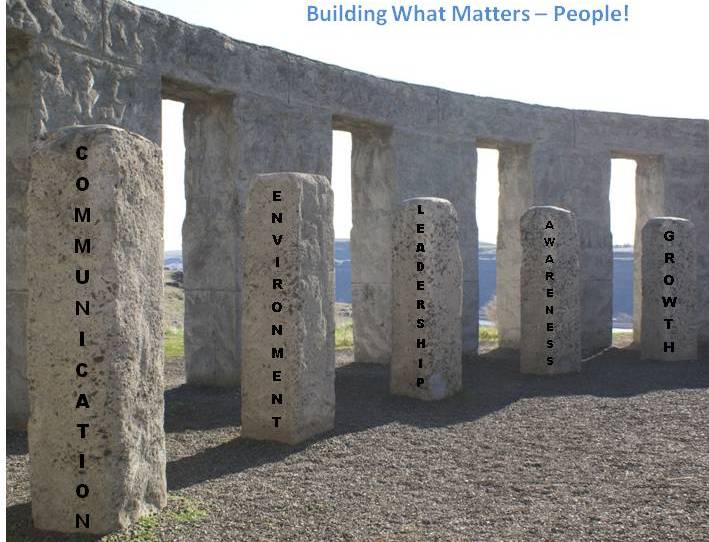 This is the 11th of 16 weekly installments on The 5 Pillars of Influential Leadership. Every Thursday, I will break down the 5 Pillars and show you how becoming and influential leader will not only improve your job skills but your personal life as well.
The 5 Pillars is a project that I have been working on for almost two years and had a great time with the official launch of “The 5 Pillars of Influential Leadership” Coaching program on May 23th.
Why the 5 Pillars? I have spent more than 30 years in the business world and although it has been primarily in the Construction world, the 5 Pillars philosophy works across all industries. In fact, while developing this program I realized that it can have a significant impact on your personal life as well.
I will break down each Pillar into three sections, personal, business and community. Any growth or improvement needs to start within, with the end goal of influencing the community you live in. In this post we will take a look at PERSONAL COMMUNICATION.
Whoever said “Communication is the key to everything” was right. Effective communication skills not only will deliver your message correctly, but will allow you to continue to move in a positive direction towards your goals.
CHARISMA
Charisma is the unique quality that some people have that enables them to add expression such as body language and tonality to the way in which they communicate. Clearly some people are more charismatic than others, but we all have the ability to express our words in a passionate way.
PREPARATION
Nothing is worse that listening to someone who has no idea what they are talking about. Actually there is one thing worse … when they act like they do know when they don’t. If you are not prepared to speak or answer intelligently, don’t!
ENTHUSIASM
Unlike charisma, enthusiasm is simply being excited about what your communicating. I believe charisma is something you have but enthusiasm is contagious. Be enthusiastic in your communication and others will be as well.
LISTENING
Listening is the most important part of communication. When we listen to what is being said we show respect. We also actually understand better what is being said by keeping our mouths closed. Focus on the individual that is speaking and let them finish before you interject. I was once told, “don’t write yourself into the story, let the person you are speaking with do it for you.”
INTUITION
I believe intuition is most powerful when we are good listeners. Intuition is the product of our life experiences that have been stored away in our subconscious as manifested by a triggering event. We all have it, but it takes awareness to access it.
AUTHENTICITY
Nobody likes a fake. If you come across as authentic, people will value your words or your message. If you do not appear authentic, you will lose the interest of your audience fast and forever.
PATIENCE
Remember that listening thing? Sometimes it requires a great deal of patience to hear another person out. We have a tendency to want to interject with the “genius” contribution we just came up with. Be patient and let the other person finish and you will gain their confidence in you.
HUMILITY
Be willing to admit your mistakes and do not boast of your successes. Humility is a great way to show others that you are sincere and truly care. The opposite side of humility is arrogance. Have you seen anything good come from that lately?
HONESTY
Honesty is the best policy. You never have to remember the truth and once you are viewed as an honest person, you become an influential person. People won’t buy in to what you are doing if they don’t buy into you.
The 5 Pillars coaching program will take each topic to a much deeper level. We will explore open ended questions and how they are directly impacting your life and more specifically in this segment, will allow you to evaluate and understand your role in growing your business.
In the mean time, start asking the type of questions that will result in better answers. When you ask “How can I” you get an answer that will move the needle. “What can I do today to improve the way I communicate with others?” Answer that question, act on it, and you will succeed.
RELATED:
- Click here to see Part 1
- Click here to see Part 2
- Click here to see Part 3
- Click here to see Part 4
- Click here to see Part 5
- Click here to see Part 6
- Click here to see Part 7
- Click here to see Part 8
- Click here to see Part 9
- Click here to see Part 10
- For more on The 5 Pillars of Influential Leadership and to view my video click here
- To view my guest post in the 2013 International Leadership Blogathon click here
***********************************************************************
Don’t miss a single post from Building What Matters by subscribing at the top left of this page.
Help support us by clicking here and Liking our facebook page
Barry Smith 6/20/13 photo by author © Building What Matters 2013
The post The 5 Pillars Of Influential Leadership – Part 11: My Communication appeared first on BUILDING WHAT MATTERS.COM.
]]>The post The Law Of Awareness – You Must Know Yourself To Grow Yourself appeared first on BUILDING WHAT MATTERS.COM.
]]> Yesterday I posted about the fact that kids ask better questions than adults. After several conversations in the last twenty four hours, I believe this is due to their level of awareness. That’s right, I said children have better awareness than adults. Why? Because they don’t have all the “stuff” that we have getting in the way.
Think about it, have you ever just watched a three or four year old looking at the world around them. They are devouring every last piece of information out there. They notice things we don’t all the time. You have said it before … “that kid doesn’t miss a thing.”
John Maxwell in his The 15 Invaluable Laws of Growth suggests that we are in one of three levels as related to the Law of Awareness:
“You must know yourself to grow yourself”
In order to know yourself, you have to increase your level of awareness. He describes three levels to consider as we develop the awareness needed for growth.
1. PEOPLE WHO DON’T KNOW WHAT THEY WOULD LIKE TO DO
We all know this person. They are not happy with what they are doing and have no real idea on what they would like to be doing. The question becomes “why don’t they know?” Probably because they are not even aware of what is important to them, what they are passionate about.
I think there are many people that are so busy surviving that they don’t even have the time to think about what it is that they want to do. If you know this person, talk to them about it. Life is too precious to waste and maybe you can be the catalyst to make someone more aware of what matters.
2. PEOPLE WHO KNOW WHAT THEY WOULD LIKE TO DO BUT DON’T DO IT
Most people are probably at this level. They know what they would like to do but their current level of awareness most likely has some type of limiting belief that prevents them from doing what they want to do. Their dominating thoughts consume their state of awareness and they simply get stuck where they are.
3. PEOPLE WHO KNOW WHAT THEY WOULD LIKE TO DO AND DO IT
Here is the sweet spot. Knowing what you want to do and doing it. If you are at this level, you know and appreciate the quality of life that you enjoy. You are totally aware of the challenges that we face each day but have the cognitive ability to process what is needed to deal with them and move on. With this level of awareness, you should be helping others increase their awareness.
So there it is. You fit into one of these levels. If you are in level one or two, block out some time to look around you and see how the level three people are doing it. Ask them questions. Ask for help. What? Ask for help … yes ask for help. Most people are willing to help if you simply ask.
If you are a level three person. Use the level of awareness that you have and make a difference. Maxwell gives us a very powerful statement when he says:
“There are two great days in a person’s life: the day you were born and the day you discover why.”
When you realize why you are here, what your purpose is, you will find that you become increasingly aware of what it is that you are supposed to do. Do you know why you are here?
**********************************************************************
Next Up: Law #3 The Law of the Mirror.
Don’t miss any of these Invaluable Laws by subscribing at the upper left of this page.
Help support us by clicking here and Liking our facebook page
Barry Smith www.buildingwhatmatters.com 10/17/12 photo by author
The post The Law Of Awareness – You Must Know Yourself To Grow Yourself appeared first on BUILDING WHAT MATTERS.COM.
]]>The post The Law of Intuition – The Insight Of A Leader appeared first on BUILDING WHAT MATTERS.COM.
]]>
Today we celebrate our Nation’s Independence Day. I wonder what level of intuition influenced our founding fathers, our original leaders, in founding this County. John Maxwell in his The 21 Irrefutable Laws of Leadership states:
“Successful leaders see every situation in terms of available resources: money, raw materials, technology, and people. They can sense people’s hopes, fears, and concerns. And they can step back from the moment and see not only where they and their people have gone, but also where they are heading. It’s as if they can smell change in the wind.”
I believe that Maxwell intended this to be directed at today’s leaders, but am amazed at how accurately it must have applied to the likes of great leaders such as George Washington and Thomas Jefferson. It also appears that this idea has been a constant throughout the history of our country. Intuition, although may be a most difficult concept to explain, is clearly a tool that all of use in making decisions every day.
As leaders, we have the ability to remove ourselves from what is happening at any moment and the responsibility to evaluate where our team is headed. A leaders intuition is quite often, the one thing that defines a great leader. It could be argued that some are born with great leadership intuition and others develop it through failure and success. The challenge comes in processing the information into a mindset that, although can’t be defined on paper, will prove to be the guiding force in decision making. The principles of leadership remain fairly consistent, but the application of a leader’s skills change with every situation.
I would suggest that intuition is merely a product of the knowledge gained during the trials and tribulations that we encounter every day. That “gut feel” that you have in a specific situation is simply a reaction to the events that you have previously experienced.
DEVELOPING INTUITION BY CHANGING YOUR THINKING
Our intuitive capabilities can be strengthened by changing the way we think. Dr. Wayne Dyer said “If you change the way you look at things, the things you look at change.” When we begin to process our experiences not just as an event but as a lesson learned, we add to our intuitive skill set. That database of memories that exists in our mind that creates that “gut feel.”
LEADERS SOLVE PROBLEMS USING THE LAW OF INTUITION
Sometimes simply analyzing the facts of a situation will not produce the solution to the problem. Let’s just accept that intuition is the result of preconditioned thoughts based on our previous experiences. It would logically follow that these experiences, although not directly related to the problem at hand, can provide the needed intuition to come up with a solution.
Regardless of your opinion on how we develop intuition, one thing is constant, we all have it and we all use it. As you continue forward in this thing called life, I would encourage you to change the way you view your experiences. Every choice we make has a result and every result can provide an additional opportunity to gain knowledge.
The choice you have to make is whether or not you will use this knowledge to help develop your intuitive skills. What is your gut telling you right now?
Next Up: Law #9 – The Law of Magnetism
Barry Smith www.buildingwhatmatters.com 7/4/12
The post The Law of Intuition – The Insight Of A Leader appeared first on BUILDING WHAT MATTERS.COM.
]]>